THE SCHOOL OF KAMOS
Connecting Real-world Dev & Academic Intelligence with Intuitive Metaphors
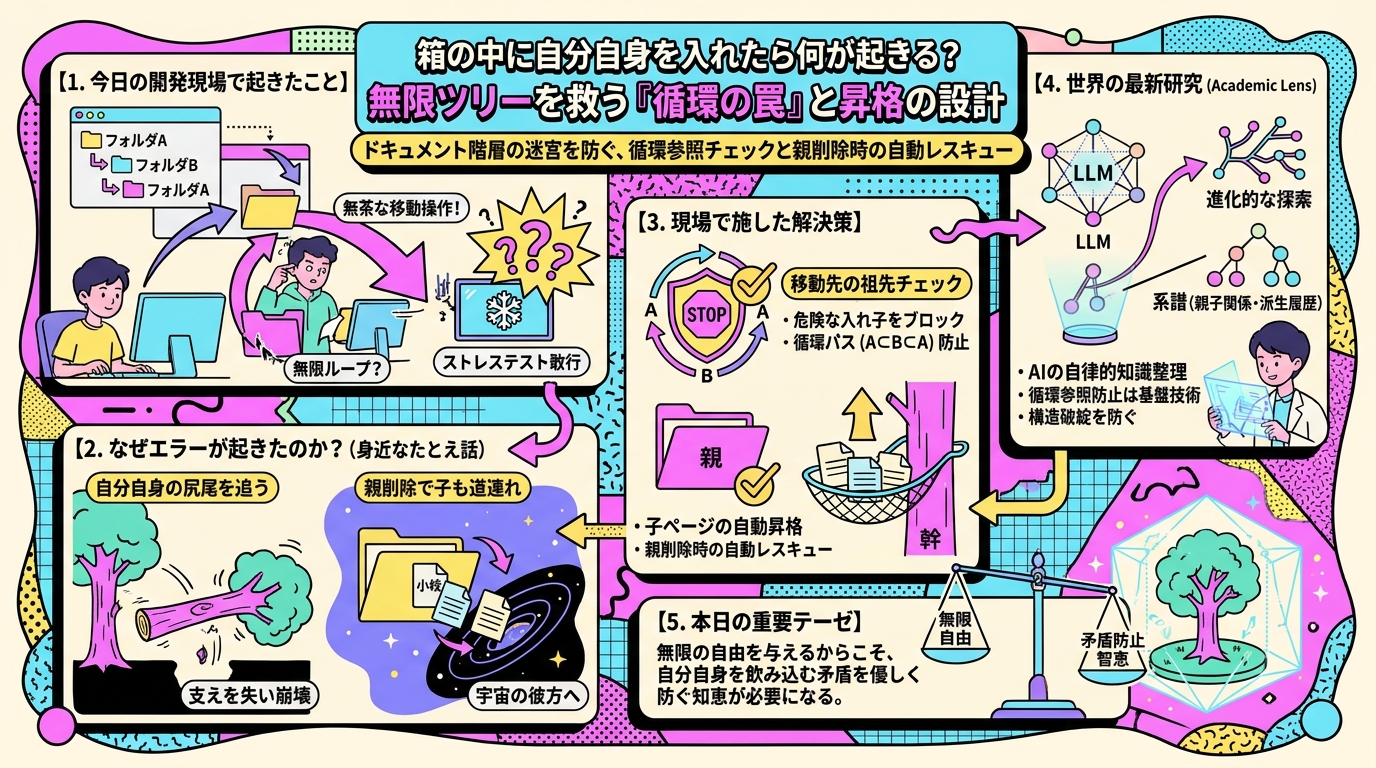
What Happens When You Put a Box Inside Itself? Escaping Circular Traps and Designing Promotion for Infinite Trees
Preventing Labyrinths in Document Hierarchies: Circular Reference Checks and Automatic Rescue on Parent Deletion
What happens if you place Folder B inside Folder A, and then throw Folder A right back inside Folder B? While building an infinite hierarchy tree for knowledge documents, our engineering team deliberately executed this reckless move in the UI as a stress test. The goal: to verify whether the system would chase its own tail into an infinite loop's black hole as AI agents and human users freely organize evolving knowledge.
In our test environment, the tree predictably chased its own descendants ad infinitum, sending browser rendering into a dead freeze. It was like lopping off a thick branch from a tree and attempting to balance the entire tree on top of that very branch—severed from the ground, the tree collapses in midair. Furthermore, the test exposed another peril: deleting a parent folder would instantly drag every precious twig (child page) down with it, vanishing into the void.
From this experiment emerged two golden rules: 'Destination Ancestry Validation' and 'Automatic Child Page Promotion.' Before an item moves, the system instantly cross-checks that the destination is not one of its own descendants, nipping hazardous nesting in the bud. Moreover, when a parent page is deleted, a protective rule automatically promotes its child pages up one tier, grafting them cleanly back onto the main trunk. In a world where AI orchestrates vast oceans of information, the greater the degree of freedom, the more vital these quiet safety lines become.
"Because we grant infinite freedom, we need the quiet wisdom to prevent systems from swallowing themselves."Key Takeaway
📖 1-Minute Lexicon
A state where references form a closed loop—such as A containing B while B contains A—trapping the system in an infinite loop.
A mechanism that automatically elevates nested contents one level higher to a safe tier when a parent folder is deleted, preventing orphaned data.
Safe Design for Infinite Trees: Circular Reference Guard & Auto-Rescue
Live Frontier Pulse: Real-World AI Trends
PFN Releases World-Class Edge AI Translation LLM 'PLaMo 3 Translate' with Open Weights
Preferred Networks has open-sourced a high-performance translation-specialized LLM. Enabling agile execution directly on edge devices, it achieves high-precision natural language processing without relying on cloud communication.
Ricoh and Kawasaki Heavy Industries Form Strategic Partnership to Leverage Engineering Knowledge Assets with AI
The two companies have launched a collaboration to organically interconnect vast engineering knowledge assets, such as design blueprints and technical documents, using AI to accelerate operational efficiency and technical knowledge transfer.
How Does This Connect to Global Frontier Research?
This cutting-edge research discusses the importance of properly recognizing and controlling 'lineage' (parent-child relationships and derivative histories) of generated data and structures in evolutionary search using LLMs. When AI autonomously spawns and arranges hypotheses or documents, failing to trace genealogical trees leads to redundant loops and structural breakdown. Our frontline implementation—preventing circular references and maintaining parent-child integrity—deeply resonates with the foundational technologies required for AI agents to self-evolve complex knowledge networks.
Why does a system or interface freeze when a 'circular reference' occurs in document management?
Past School Paper Backnumbers

How Stripping Away Invisible Padding and Caching Dramatically Sharpened Our AI Design Canvas
Why an AI Narrator Reads 'Stage Directions' Aloud—and the Art of Scrubbing the Script Clean
Balancing 'This Year's Certainty' with 'Next Year's Foresight': System Design That Reserves the Future Without Mixing Schedules

An X-Ray of the Play Button: The Precision Tuning Behind Unhurried Five-Minute AI Narration

Stop the AI, and the Archive Lives On: Designing for Completion at Zero Maintenance Cost

What Appeared When We Removed the Neon and Technical Gauges: Crafting Effortless Wayfinding Across 11 WebGPU Works

20,000 Characters Distilled into a Single Four-Quadrant Diagram: Where Long-Form Summarization Stands Today with the Latest Image Model, Nano Banana 2.1

Why Can't AI Keep Drawing the Same Object? A Visual Anchor to Prevent Structural Drift in 5-Panel Sketches
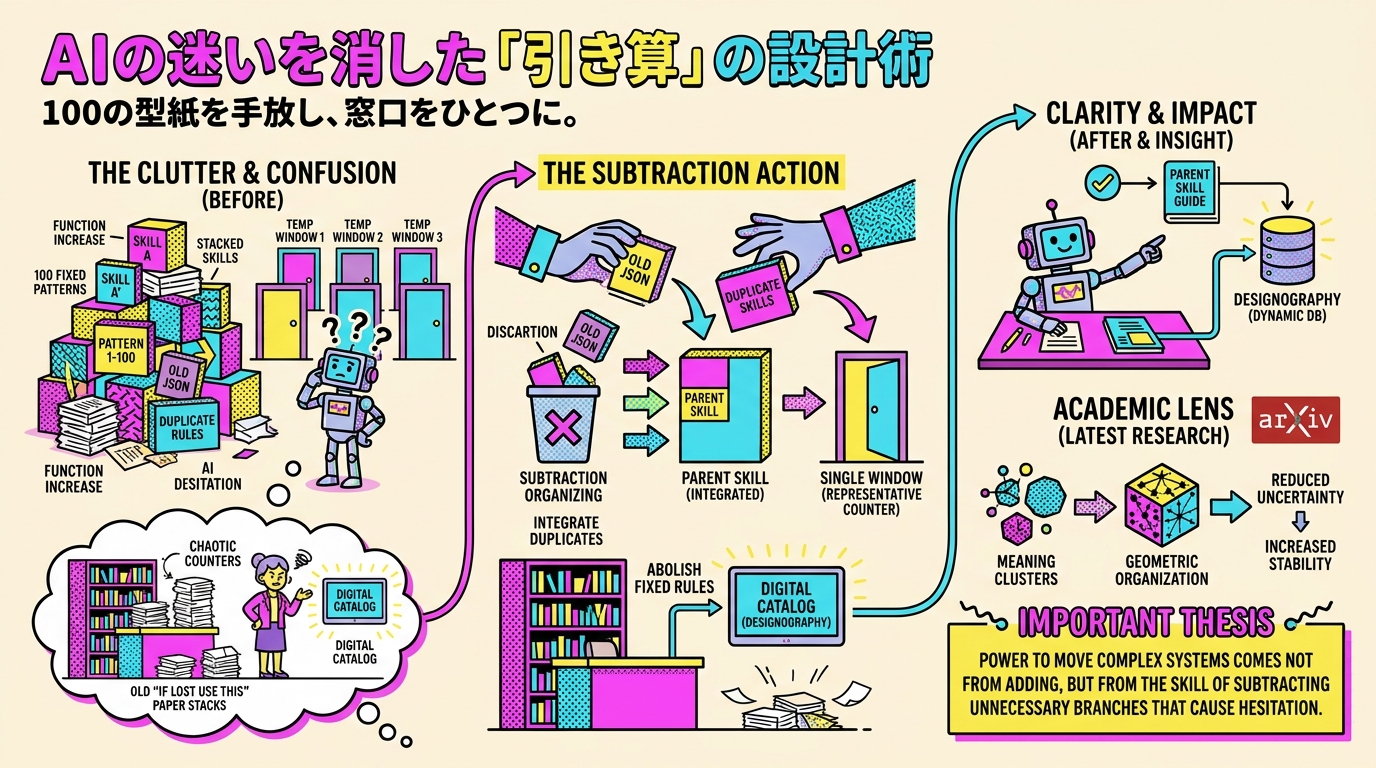
Letting Go of 100 Templates for a Single Desk: The Art of Subtractive Design That Eliminated AI Hesitation

What If You Animated '1,000 Arms' in a Browser? A Lightweight 3D Exhibition Experiment Powered by AI and WebGPU
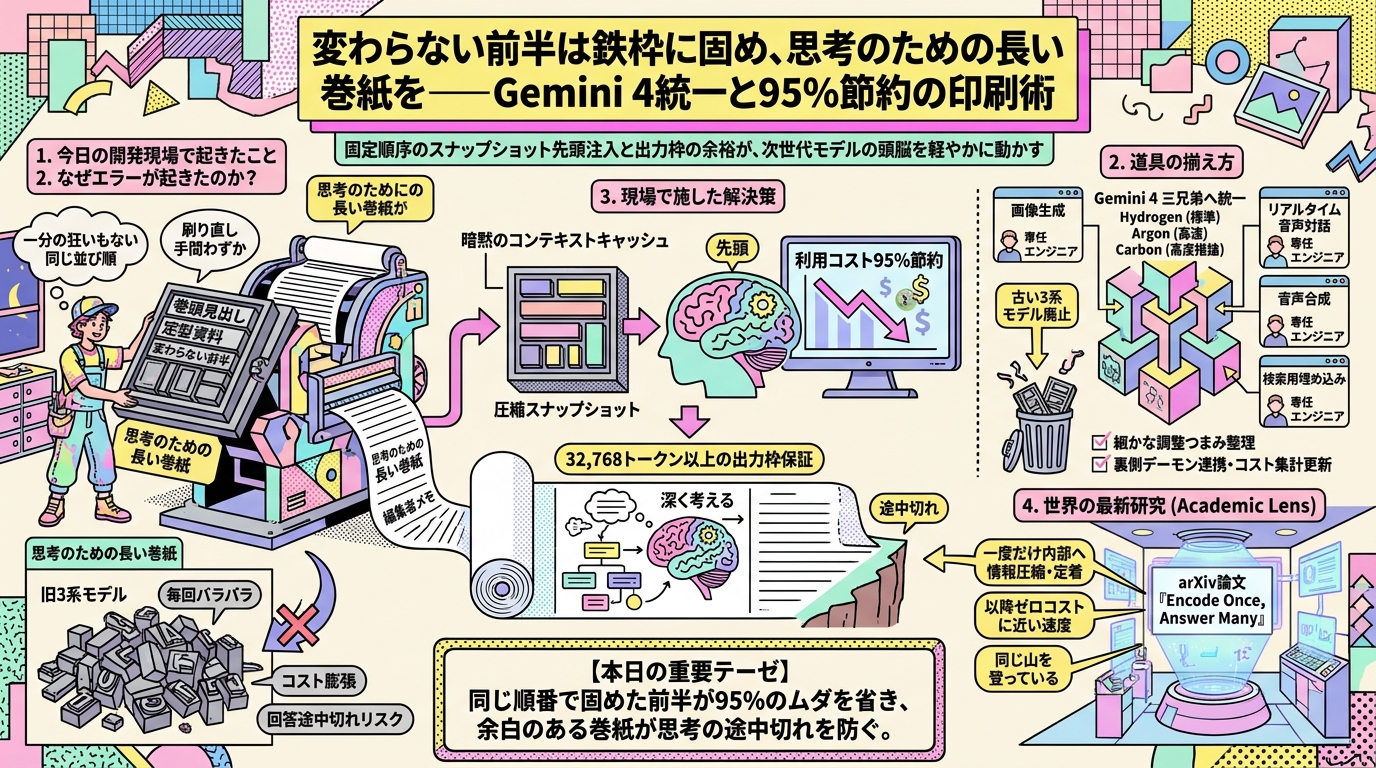
Locking the Constant Lead in Iron, Unrolling Long Scrolls for Thought — Gemini 4 Unification and the Art of 95% Printing Savings
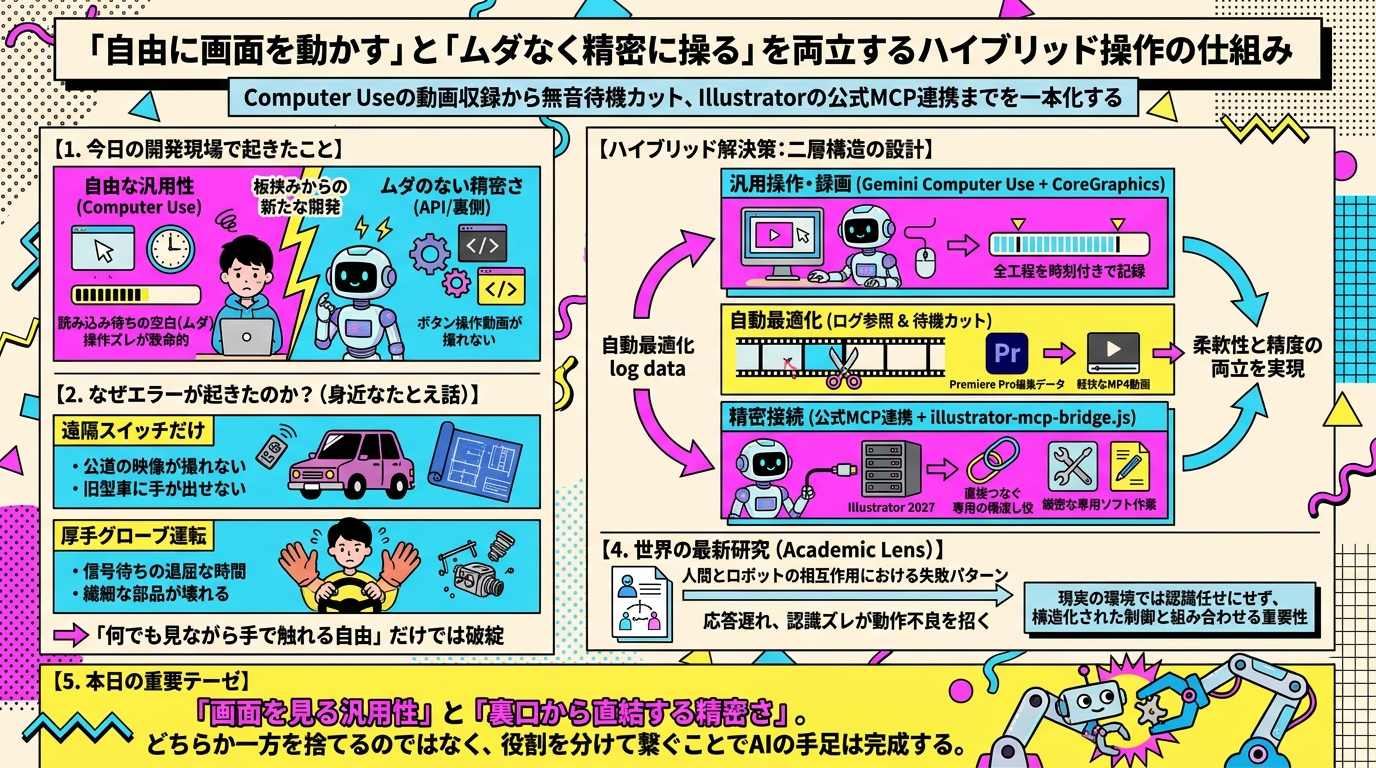
A Hybrid Control Architecture Bridging Free-Form Screen Navigation and Lean, Precision Execution
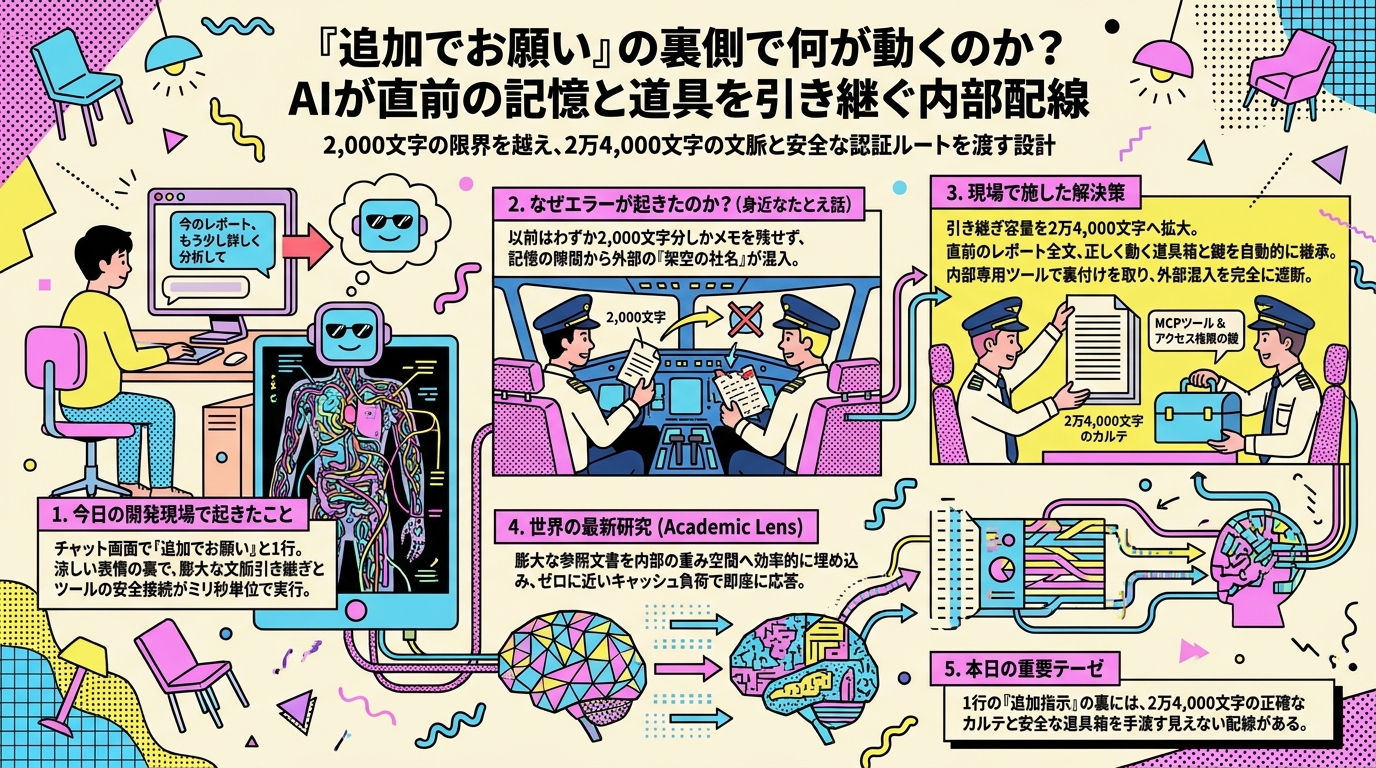
Behind "Just One More Request": The Internal Wiring That Hands Off Memory and Tools Between AIs